
What is a reptile?
What this free course covers, and the shared biology that makes a reptile a reptile, from ectothermy to scaly, water-resistant skin.
~8 minutes
About this course
Welcome to Reptiles in the Wild: An Introduction, a free course from the Herpetological & Wildlife Academy (HWA).
Reptiles inhabit some of the most remarkable environments on Earth, from scorching deserts and tropical rainforests to freshwater wetlands, mountain ranges and open savannahs. Although often misunderstood, these animals have evolved an extraordinary range of adaptations that allow them to survive, reproduce and thrive in environments that would challenge many other vertebrates.
From the heat-sensing abilities of certain snakes to the colour-changing mechanisms of chameleons, the water-conserving adaptations of desert-dwelling reptiles and the complex relationships between predators and prey, reptiles provide fascinating opportunities to understand evolution, ecology, animal behaviour and conservation.
In this course, you will explore reptiles as wild animals first and foremost. You will learn how they interact with their environments, how scientists study them, why they are important to ecosystems and what threatens their survival.
The course is a structured introduction to field herpetology, and it is completely free. It has four modules:
| Module | What you will explore |
|---|---|
| 1. The World of Reptiles | What a reptile is, the major groups, where reptiles live and why biodiversity matters |
| 2. Reptile Adaptations and Survival | Temperature, water, senses, camouflage and defence |
| 3. Reptile Behaviour and Ecology | Feeding, reproduction, seasonal activity, communication and ecosystems |
| 4. Reptile Conservation and Field Herpetology | Threats, research methods, responsible observation and conservation in practice |
Learning is self-paced. Each module ends with a glossary and a short quiz of 5 multiple-choice questions. Complete all four modules and you will receive a certificate of completion, graded Pass, Merit or Distinction.
By the end, you should have a stronger understanding of reptile biology and a foundation for further study in herpetology and wildlife conservation.
About this module
Before we can understand reptiles in the wild, we need to understand what makes a reptile a reptile. Their appearance can vary enormously, from the heavily armoured body of a crocodile to the streamlined form of a sea snake, yet they share important biological characteristics.
In this module, you will explore reptile classification, their evolutionary history, their major groups and the remarkable diversity of habitats they occupy. You will also discover why the term reptile encompasses animals with very different lifestyles, diets and ecological roles.
Module learning outcomes
By the end of this module, you will be able to:
- Describe the main features shared by reptiles, including ectothermy and keratinised skin.
- Explain how reptiles use behaviour to regulate their body temperature.
- Name the five major groups of living reptiles and give an example of each.
- Explain what a microhabitat is and why it matters.
- Describe some of the ecological roles reptiles play and why biodiversity matters.
What is a reptile?
Reptiles are vertebrate animals belonging to the evolutionary group Reptilia. Living reptiles include turtles and tortoises, crocodilians, tuatara, lizards and snakes. Birds are also part of the wider reptilian evolutionary lineage, although they are generally studied separately from non-avian reptiles.
Ectothermy
Most reptiles are ectothermic. This means their body temperature depends substantially on heat exchanged with the environment, rather than being maintained at a consistently high level through internal metabolic heat production, as in mammals and birds.
However, ectothermy does not mean reptiles have no control over their body temperature. Many actively select different microhabitats, bask in sunlight, retreat into shade or shelter underground to regulate their temperatures behaviourally.
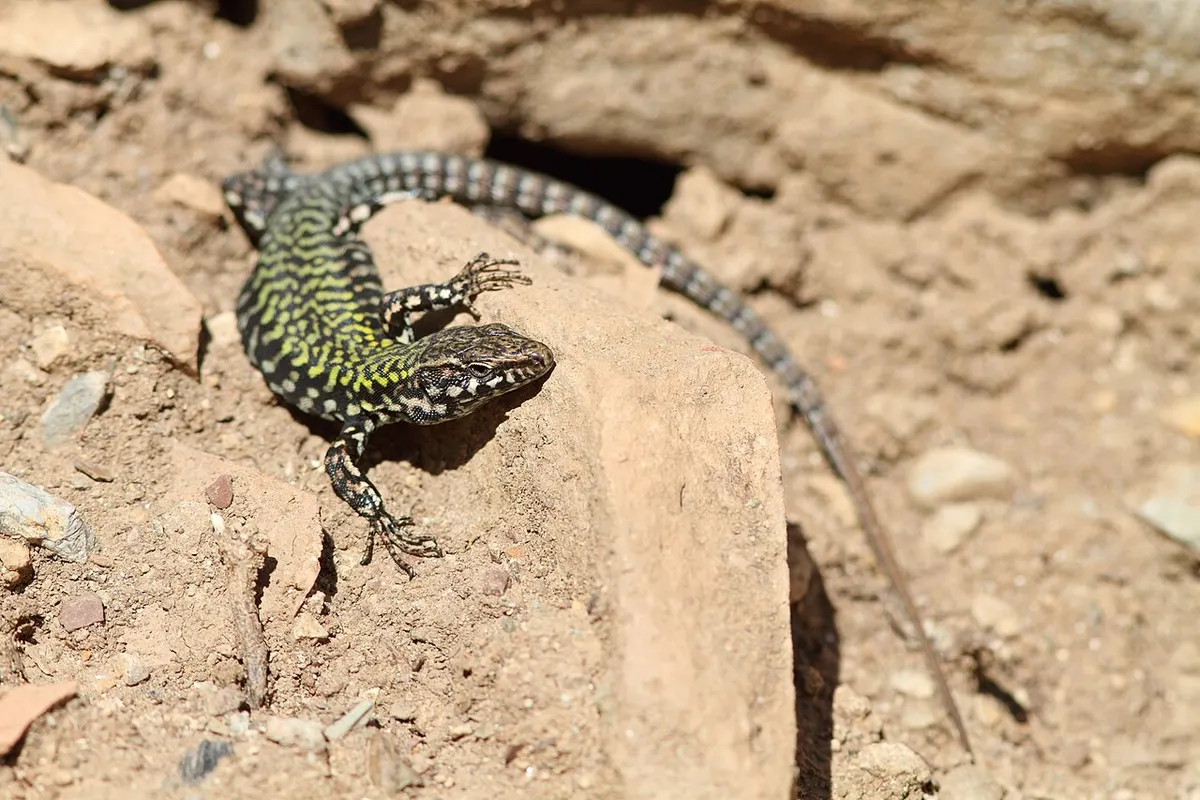
Photo 1.1 — A common wall lizard (Podarcis muralis) basking on a rock in Maremma Regional Park, Italy. The sun-warmed rock helps it heat up, and the crevice behind it offers a quick retreat if it gets too hot. Photo: Bouke ten Cate, CC BY 4.0, via Wikimedia Commons.
Consider a wild lizard on a cool morning. It may move onto a sunlit rock to warm up, increasing its capacity for movement, feeding and digestion. As the day becomes hotter, the same lizard may retreat beneath vegetation or into a crevice to avoid overheating.
This behaviour is known as behavioural thermoregulation.
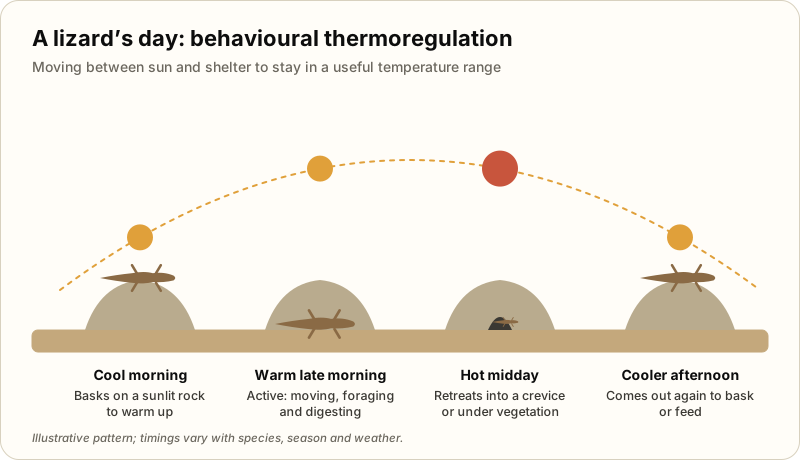
Figure 1.1 — A typical pattern of behavioural thermoregulation across a warm day.
Skin and breathing
Reptiles also possess keratinised skin structures, including scales, scutes or other protective coverings. These help reduce water loss and provide protection from abrasion and the physical demands of their environments. Unlike amphibians, reptiles generally have skin that is much less permeable to water.
Most reptiles breathe using lungs throughout their lives. Even aquatic reptiles such as sea turtles and sea snakes must surface to breathe atmospheric oxygen.
Key concept: A reptile’s biology cannot be understood separately from its environment. Temperature, moisture, shelter and access to food all influence how it survives.
Lesson summary
- Living reptiles include turtles and tortoises, crocodilians, tuatara, lizards and snakes; birds belong to the wider reptilian lineage.
- Most reptiles are ectothermic, but they control their body temperature through behaviour, such as basking and seeking shade.
- Keratinised scales or scutes reduce water loss and protect the body, and reptiles breathe with lungs throughout life.