
Understanding reptiles
What makes an animal a reptile, the four living groups, and why accurate identification underpins good husbandry.
~10 minutes
About this module
In this module, you will develop a foundational understanding of reptiles and the principles of responsible reptile husbandry. You will explore the defining characteristics of reptiles, their biological adaptations, diversity and natural habitats, and how these influence their captive care requirements.
You will also learn about the importance of understanding species-specific needs, recognising reptiles as animals with individual welfare requirements, and establishing the foundations for providing appropriate housing, nutrition, environmental conditions and routine care. By the end of this module, you will understand why successful reptile keeping requires knowledge, preparation, observation and a commitment to maintaining high standards of animal welfare.
1.1 What is a reptile?
Reptiles are vertebrate animals within the broader group of amniotes. Vertebrates possess a vertebral column, while amniotes develop an embryo within specialised membranes that support development on land or within an egg.
Living reptiles exhibit a wide range of body forms, behaviours and ecological adaptations. They occupy environments ranging from deserts and grasslands to tropical forests, freshwater systems and marine habitats.
Although reptiles are often associated with dry, scaly skin, this description does not capture the full diversity of the group. Some species are highly aquatic, others spend most of their time underground, and some are specialised climbers.
Reptile skin is covered by keratinised structures, including scales or scutes, which help protect the body and reduce water loss. The exact structure varies between groups. Unlike amphibians, reptiles generally have skin that is less permeable to water, although their water balance still depends on environmental conditions and physiological adaptations.
For a reptile keeper, understanding these biological characteristics provides the foundation for decisions about enclosure design, humidity, hydration, handling and environmental control.
1.2 The four major groups of living reptiles
For introductory husbandry, living reptiles can be studied through four major lineages.
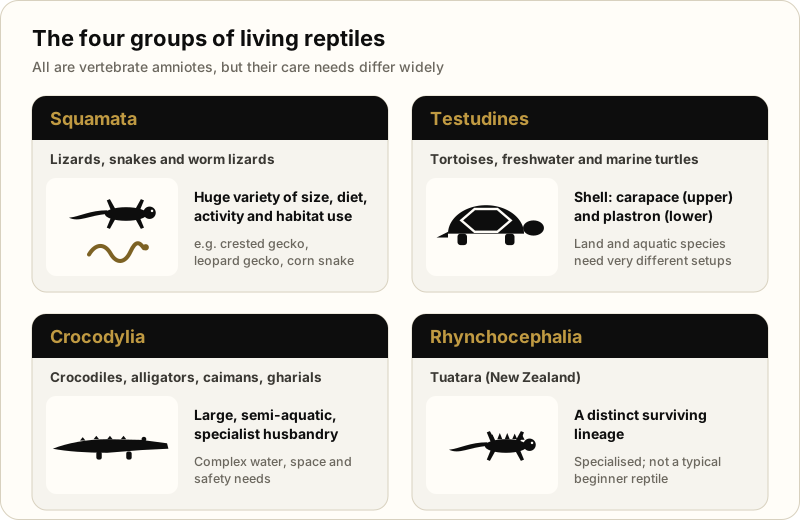
Figure 1.1 — The four groups of living reptiles.
Squamata — snakes and lizards
Squamates include geckos, skinks, monitors, iguanas, chameleons, snakes and worm lizards. They show enormous variation in body size, diet, activity patterns and habitat use.
For example, a crested gecko is adapted to an arboreal lifestyle, whereas a leopard gecko commonly uses terrestrial environments and shelters. A burrowing skink may spend much of its time beneath the substrate.
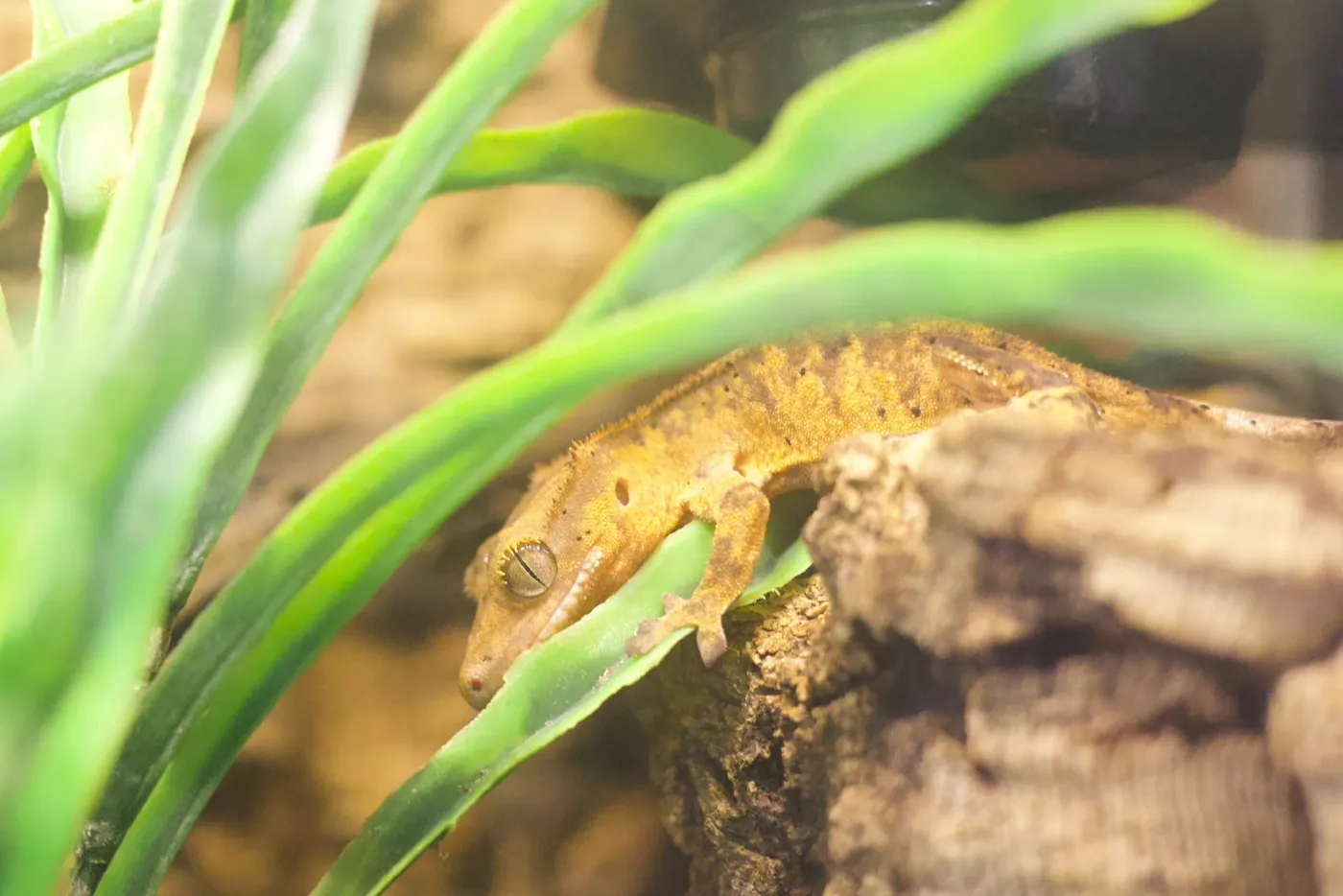
Photo 1.1 — A crested gecko (Correlophus ciliatus) on cork bark among foliage. As an arboreal species, it needs climbing structures, elevated resting places and cover.
These differences directly influence captive care. Arboreal species may require vertical climbing opportunities and elevated resting places, while terrestrial species need suitable floor space and ground-level shelters.
Testudines — turtles and tortoises
Testudines possess a specialised shell consisting of a carapace, the upper portion, and a plastron, the lower portion. Their anatomy, movement and ecology differ from those of squamates.
The group includes terrestrial tortoises, freshwater turtles and marine turtles. Their requirements cannot be generalised across the entire group.
For example, a terrestrial tortoise requires suitable land-based space, substrate and opportunities for species-appropriate movement. An aquatic turtle may need carefully designed aquatic space, water-quality management, appropriate filtration and a suitable basking area.
Crocodylia — crocodiles, alligators, caimans and gharials
Crocodylians are large, predominantly semi-aquatic reptiles with specialised anatomy and behaviour. Their husbandry involves complex considerations, including water management, thermal conditions, space, secure containment and significant handling risks.
They are useful examples of why the word reptile does not imply that all animals can be cared for using the same equipment, techniques or level of expertise.
Rhynchocephalia — tuatara
Tuatara are native to New Zealand and represent a distinct surviving reptile lineage. They have specialised biological requirements and are not typical beginner captive reptiles.
Their inclusion demonstrates the evolutionary diversity of living reptiles and why husbandry information must be specific to the animal being maintained.
1.3 Reptiles and their environments
A reptile's anatomy, physiology and behaviour are shaped by its evolutionary history and ecology.
Consider three examples:
- A climbing gecko may rely on elevated surfaces, secure resting places and appropriate climbing structures.
- A burrowing species may depend on substrate that allows it to create or occupy shelters.
- A semi-aquatic turtle may require both aquatic habitat and access to a suitable dry basking area.
The enclosure must therefore support the animal's functional needs, not simply provide enough room to survive.
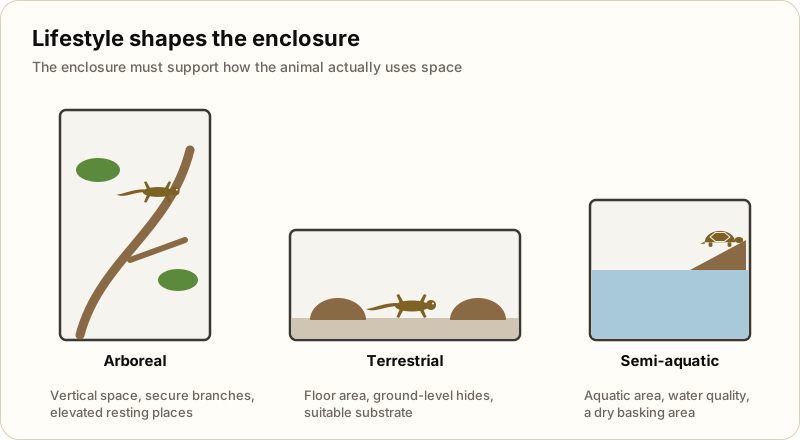
Figure 1.2 — How an animal uses space shapes the enclosure it needs.
1.4 Why biological classification matters in husbandry
Classification helps us organise knowledge, but it does not replace species-specific research.
Two reptiles within the same family may differ considerably in their temperature preferences, dietary requirements, reproductive biology and activity patterns.
A keeper should establish the identity of an animal as accurately as possible before selecting husbandry parameters. Common names can be ambiguous, and care advice intended for one species may be unsuitable for another.
Scientific names are especially useful when researching husbandry, veterinary literature and conservation status because they provide a more precise reference than common names alone.
| Scientific name | Common names you may see |
|---|---|
| Python regius | Royal python, ball python |
| Pantherophis guttatus | Corn snake, red rat snake |
| Pogona vitticeps | Bearded dragon, central bearded dragon, inland bearded dragon |
| Correlophus ciliatus | Crested gecko, eyelash gecko |
Table 1.1 — One species can have several common names. The scientific name stays the same.
Key learning points
- Reptiles are a diverse group of vertebrate amniotes.
- Living reptiles include squamates, testudines, crocodilians and rhynchocephalians.
- Their anatomy and ecological adaptations influence captive requirements.
- Common names may be ambiguous; accurate identification is important.
- Classification provides a starting point, but husbandry must be tailored to the species.