
Introducing the leopard gecko
The species, what makes it distinctive and where it sits in the animal kingdom.
~8 minutes
About this course
Welcome to the HWA Leopard Gecko Care course.
This course has been developed to provide students with a comprehensive understanding of the leopard gecko, one of the most established and recognisable species within the captive reptile-keeping community.
The leopard gecko (Eublepharis macularius) is a terrestrial gecko native to parts of South Asia and the Middle East. Its distinctive spotted appearance, movable eyelids, relatively manageable size and generally adaptable nature have contributed to its popularity amongst reptile keepers worldwide.
Despite being considered a suitable species for beginners, leopard geckos have specific environmental, nutritional and biological requirements that must be understood to maintain good long-term health and welfare.
Throughout this course, students will explore the species' natural origins, anatomy, behaviour, environmental requirements, feeding, health management, reproduction and genetics.
Particular attention will be given to understanding the differences between the leopard gecko's natural environment and the conditions required to maintain it successfully in captivity.
The objective is to develop knowledgeable keepers who understand not only what a leopard gecko requires, but why those requirements are important.
The course has five modules. Each module ends with a glossary of key terms and a multiple-choice quiz to check your understanding.
Important husbandry disclaimer
Every reptile keeper has their own methods, experiences and approaches to animal husbandry. There can be differences in the way individual keepers manage their animals, and more than one method may achieve appropriate welfare outcomes.
The information presented throughout this course reflects what we at the Herpetological & Wildlife Academy have learnt through over 15 years of keeping, maintaining and breeding reptiles in captivity.
Our recommendations are based on our practical experience, established husbandry knowledge and recognised animal welfare principles.
Reptile husbandry is continually developing as further research becomes available. We encourage students to continue their education, consider new evidence and adapt their practices where necessary.
Our priority is always the animal's health, welfare and ability to display natural behaviours. Individual animals may also have specific requirements that need to be considered.
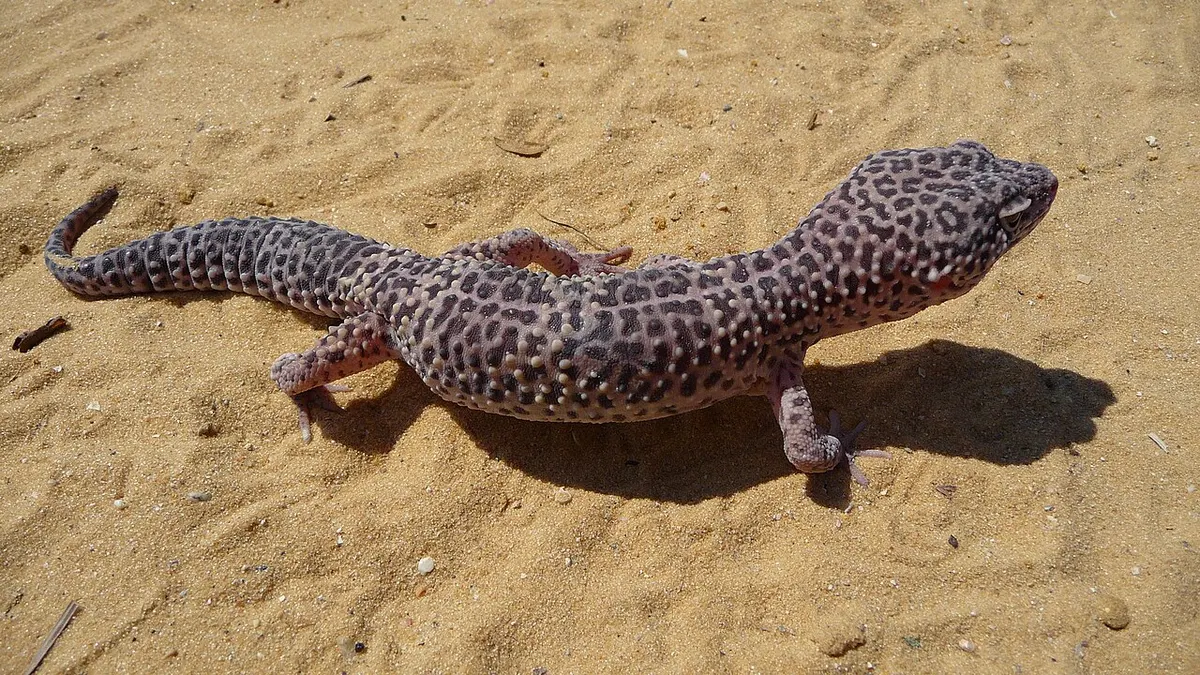
Photo 1.1 — A leopard gecko (Eublepharis macularius) showing the spotted pattern that gives the species its name. Photo: George Chernilevsky, public domain, via Wikimedia Commons.
Introduction to the species
The leopard gecko, scientifically known as Eublepharis macularius, is a small-to-medium-sized terrestrial lizard belonging to the family Eublepharidae.
It is one of the most recognisable gecko species in the reptile industry, particularly because of its distinctive spotted pattern, broad head, relatively robust body and thick, fleshy tail.
Unlike many other gecko species, leopard geckos possess movable eyelids. This is a particularly important anatomical distinction because most commonly kept geckos, such as crested geckos and day geckos, have a transparent spectacle covering their eyes rather than movable eyelids.
Leopard geckos are predominantly ground-dwelling animals that inhabit rocky, dry and seasonally variable environments.
Their natural adaptations allow them to survive in environments where temperatures can fluctuate considerably between day and night.
In captivity, they are generally considered manageable reptiles, but their welfare depends on providing suitable heating, lighting, nutrition, hydration, environmental complexity and appropriate opportunities for natural behaviour.
Scientific classification
Understanding scientific classification helps establish the leopard gecko's position within the animal kingdom.
| Rank | Classification |
|---|---|
| Kingdom | Animalia |
| Phylum | Chordata |
| Class | Reptilia |
| Order | Squamata |
| Family | Eublepharidae (eyelid geckos) |
| Genus | Eublepharis |
| Species | Eublepharis macularius |
The family Eublepharidae contains several gecko species with movable eyelids.
The genus Eublepharis contains several other species of leopard gecko from South and West Asia. The same family also includes the African fat-tailed gecko (Hemitheconyx caudicinctus), which belongs to a different genus and should not be confused with the leopard gecko.
The leopard gecko is not simply a smaller version of other commonly kept geckos. Its terrestrial lifestyle, feeding habits, anatomy and environmental requirements make it a distinct species with its own husbandry considerations.