
Introducing the corn snake
Classification, size and lifespan, and where corn snakes come from.
~8 minutes
About this course
The corn snake is one of the most popular captive-bred snake species in the world. Its manageable size, generally calm temperament, attractive colour variations and adaptability have made it a common choice for both new and experienced reptile keepers.
However, responsible corn snake husbandry involves considerably more than providing an enclosure and feeding rodents. Keepers must understand the species' natural history, environmental requirements, feeding biology, shedding process, health needs and reproductive behaviour.
This course explores corn snake care from its natural origins through to responsible breeding and long-term ownership. It is designed to help students develop the knowledge and practical skills required to maintain healthy corn snakes in captivity.
The course has five modules. Each module ends with a glossary of key terms and a multiple-choice quiz to check your understanding.
Important husbandry disclaimer
Everyone has their own way of keeping reptiles, and husbandry practices can differ between experienced keepers, breeders and professionals. The recommendations in this course reflect knowledge gained through more than 15 years of practical experience keeping and breeding reptiles in captivity, alongside established husbandry information and animal-welfare principles.
These recommendations are intended as informed guidance, not the only acceptable approach. Keepers should remain open to new scientific evidence, developments in husbandry and the individual needs of each animal.
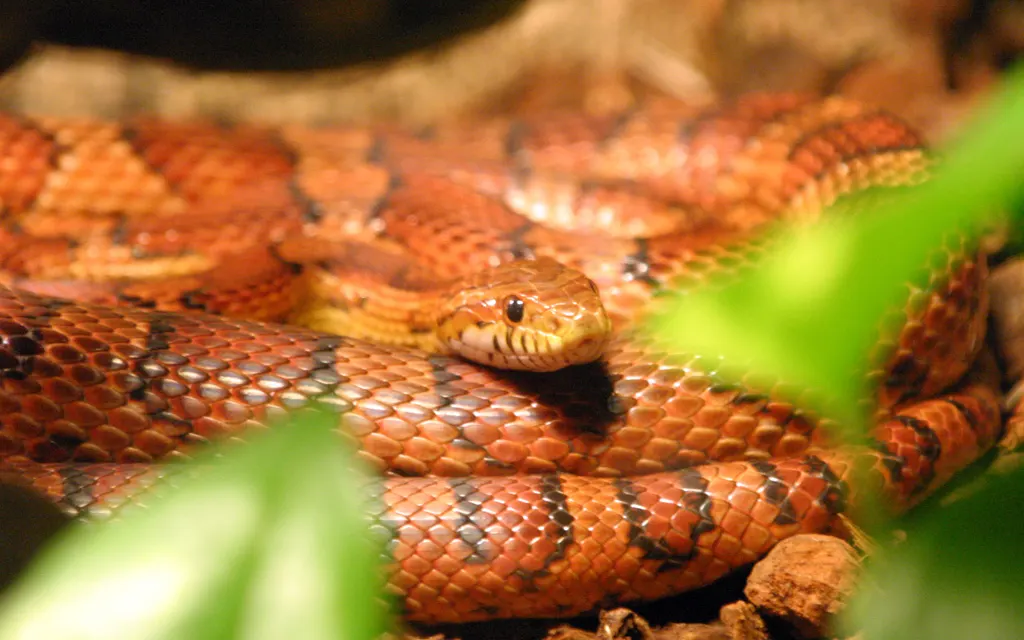
Photo 1.1 — A corn snake (Pantherophis guttatus) showing the classic orange colouring with dark-edged red blotches. Photo: Mwx, public domain, via Wikimedia Commons.
Introduction and classification
The corn snake (Pantherophis guttatus) is a non-venomous colubrid snake belonging to the family Colubridae. It was historically classified under the genus Elaphe, which is why older literature may refer to it as Elaphe guttata.
| Rank | Classification |
|---|---|
| Kingdom | Animalia |
| Phylum | Chordata |
| Class | Reptilia |
| Order | Squamata |
| Suborder | Serpentes |
| Family | Colubridae |
| Genus | Pantherophis |
| Species | Pantherophis guttatus |
Corn snakes are slender, active snakes recognised for their attractive patterns, generally manageable temperament and adaptability to captive environments.
They are constrictors. Rather than using venom, they capture prey and use muscular coils to restrain it before swallowing it whole.
Their popularity in captivity has resulted in a wide variety of selectively bred colour and pattern combinations, commonly known as morphs.
Corn snakes can reach approximately 90–150 cm in length, although larger individuals occur. Their lifespan in captivity is commonly around 15–20 years, with some living longer under suitable conditions.
Natural distribution and origins
Corn snakes are native to the southeastern United States. Their natural range includes areas of Florida, Georgia, South Carolina, North Carolina, Virginia and surrounding regions.
They occupy a variety of environments, including:
- Woodland.
- Pine forests.
- Grassland.
- Agricultural land.
- Rocky areas.
- Scrubland.
- Woodland edges.
- Areas surrounding farms and buildings.
They are particularly well known for being found around barns and agricultural buildings, where rodents are often plentiful.
The name corn snake is commonly associated with their presence around corn storage areas and agricultural environments, where they hunt rodents.
Their ability to use different habitats helps explain why they can adapt well to appropriately designed captive enclosures. However, this adaptability should never be confused with an ability to tolerate poor husbandry.