
Introducing the bearded dragon
The species, where its name comes from and how it is classified.
~8 minutes
About this course
Welcome to the HWA Bearded Dragon Care course.
This course has been developed to provide students with a comprehensive understanding of the central bearded dragon (Pogona vitticeps), one of the most recognisable and widely kept lizard species in the international reptile-keeping community.
Native to Australia, bearded dragons are members of the family Agamidae and are particularly recognised for their broad triangular heads, spiny scales, expandable throat region and distinctive behaviours.
Their generally adaptable temperament and interesting behaviour have contributed to their popularity as captive reptiles. However, their relatively manageable nature should not be mistaken for simple husbandry requirements.
Bearded dragons have specific environmental, nutritional and biological needs. In particular, appropriate UVB provision, basking temperatures, dietary balance and access to suitable environmental conditions are essential to their long-term health.
Throughout this course, students will explore the species from its natural Australian origins through to advanced captive husbandry, nutrition, health management, reproduction and genetics.
The objective is to develop an understanding of not only how to maintain a bearded dragon, but why its particular biological requirements must be met.
The course has five modules. Each module ends with a glossary of key terms and a multiple-choice quiz to check your understanding.
Important husbandry disclaimer
Every reptile keeper has their own methods, experiences and approaches to animal husbandry. There can be differences in the way individual keepers manage their animals, and more than one method may achieve appropriate welfare outcomes.
The information presented throughout this course reflects what we at the Herpetological & Wildlife Academy have learnt through over 15 years of keeping, maintaining and breeding reptiles in captivity.
Our recommendations are based on our practical experience, established husbandry knowledge and recognised animal welfare principles.
Reptile husbandry is continually developing as further research becomes available. We encourage students to continue their education, consider new evidence and adapt their practices where necessary.
Our priority is always the animal's health, welfare and ability to display natural behaviours. Individual animals may also have specific requirements that need to be considered.
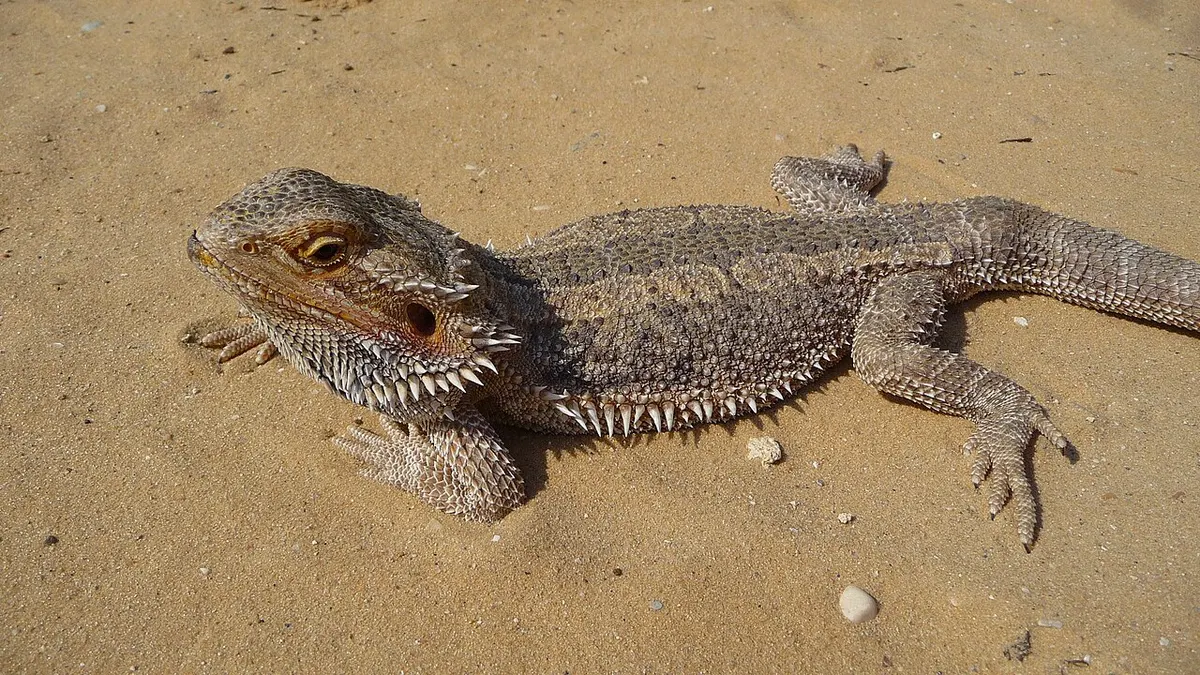
Photo 1.1 — A central bearded dragon (Pogona vitticeps). The spiny scales along the throat form the 'beard'. Photo: George Chernilevsky, public domain, via Wikimedia Commons.
Introduction to the species
The bearded dragon, scientifically known as Pogona vitticeps, is a medium-sized terrestrial and semi-arboreal lizard belonging to the family Agamidae.
The common name bearded dragon comes from its distinctive expandable throat region, which is covered in specialised spiny scales.
When threatened, excited or displaying territorial behaviour, a bearded dragon can expand this area, making it appear considerably larger.
The throat region may also darken in colour, creating the characteristic dark beard from which the species gets its name.
Bearded dragons are native to Australia and are particularly associated with arid and semi-arid environments.
They are diurnal reptiles, meaning they are active during daylight hours.
Unlike many nocturnal geckos, bearded dragons rely heavily on daytime environmental heat and sunlight to regulate their body temperature and carry out normal physiological functions.
Their popularity in captivity is largely due to their generally manageable temperament, interesting behaviours and relatively robust nature when maintained correctly.
However, their welfare depends on providing suitable lighting, heating, nutrition, space and environmental enrichment.
Scientific classification
Understanding scientific classification helps establish the bearded dragon's position within the animal kingdom.
| Rank | Classification |
|---|---|
| Kingdom | Animalia |
| Phylum | Chordata |
| Class | Reptilia |
| Order | Squamata |
| Family | Agamidae (agamid lizards, or dragons) |
| Genus | Pogona |
| Species | Pogona vitticeps |
The genus Pogona contains several recognised bearded dragon species, including:
- Pogona vitticeps – Central bearded dragon.
- Pogona barbata – Eastern bearded dragon.
- Pogona henrylawsoni – Rankin's dragon.
- Pogona minor – Western bearded dragon.
- Pogona nullarbor – Nullarbor bearded dragon.
- Pogona microlepidota – Small-scaled bearded dragon.
- Pogona mitchelli – Mitchell's bearded dragon.
Although these species share certain anatomical characteristics, they differ in geographical distribution, adult size, habitat and ecological requirements.
This course focuses specifically on Pogona vitticeps.